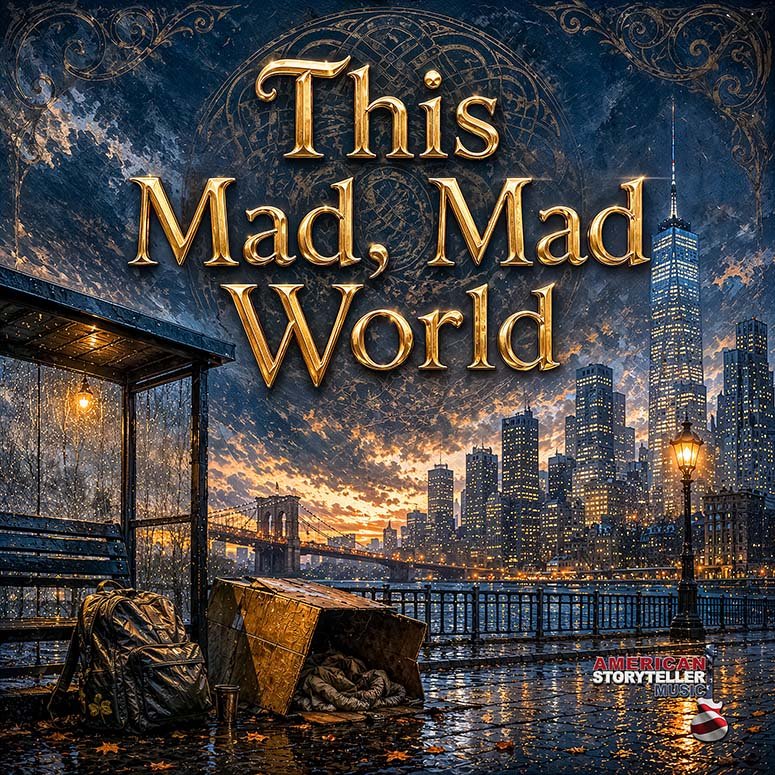
"This Mad, Mad World©"
Release Date: June 7sup>th, 2026
Lyrics by M. S. McKenzie | Performed by Songs Across America, Protected by Copyright
~ Associated State Links ~
"This Mad, Mad World"
Original Song Lyrics: Written by M. S. McKenzie, All Rights Reserved
[Instrumental Intro]
[Verse 1]
Morning breaks on New York City
Steam rising from vents in the street
A man half-sleeps under cardboard
Where both rich and hungry meet
He once worked the night shift
Used to wear his name tag proud
Now he keeps his whole life folded
In an old sack among the crowd
[Verse 2]
Down in our nation’s capital
The marble shines a glaring white
While someone hides beneath the stairs
Just trying to survive the night
Their speeches talk of freedom
Their flags still wave unfurled
Yet freedom feels like a fiction
To the forgotten of this world
[Chorus]
In this mad, mad world
Where crystal towers scrape the sky
And a working soul can lose their home
While the wealthy just pass them by
In this mad, mad world
Where mercy costs too much
Yet we keep counting all the money
But we have forgotten how to love
[Verse 3]
Atlanta hums with traffic
Under glass and neon light
A mother works two part-time jobs
But still comes up short tonight
No doctor when the fever comes
No safety net below
Just minimum wage and tired hands
With nowhere else to go
[Verse 4]
Los Angeles turns golden
When the sunset hits the palms
But tents line up like silent tombs
Beneath the freeway arms
There are children doing homework
By the glow of dashboard light
While the mansions in the canyon
Sleep well behind gates tonight
[Bridge]
And it’s not just in the cities
It’s in towns the highways miss
Where the mill closed down last winter
And left hunger in its fist
It’s the cashier with no coverage
It’s the cook who skips a meal
It’s the warehouse worker limping
Through a pain she cannot heal
And somewhere in a boardroom
Someone raises one more glass
While the people who made them wealthy
Are still running out of cash
[Additional Verse 5]
They say just work a little harder
They say dreams are always free
But dreams don’t pay the landlord
Or buy a child what they need
So we stand here in the shadows
Of a country built on gold
Asking how the richest nation
Leaves so many in the cold
[Final Chorus]
In this mad, mad world
Where crystal towers scrape the sky
And a working soul can lose their home
While the wealthy just pass them by
In this mad, mad world
Where mercy costs too much
Yet we keep counting all the money
But we have forgotten how to love
In this mad, mad world
May the lost at last be heard
May we shelter one another
In this mad, mad world
[Additional Outro for Extended Version]
Somebody’s cold tonight
Somebody’s scared tonight
Somebody’s working hard
And still can’t make it right
In this mad, mad world
In this mad, mad world
Song Description
“This Mad, Mad World” is a deeply emotional social-conscience ballad about poverty, homelessness, wage inequality, and the painful contradictions of life in modern America. Set against the backdrop of some of the nation’s most recognizable cities, the song asks how a country with so much wealth, power, and abundance can still leave millions of people struggling to survive day by day.
The song opens in New York City, where morning steam rises from the street vents and a homeless man sleeps under cardboard among the rush of city life. This image immediately establishes the central contrast of the song: towering wealth existing side by side with human suffering. The man is not presented as a statistic or a stereotype, but as someone who once worked, once wore a name tag with pride, and now carries his entire life in a backpack. That detail gives the song its human weight. It reminds the listener that homelessness is not an abstract social issue. It happens to people with histories, dignity, jobs, families, and names.
The second verse moves to Washington, D.C., where marble buildings and national symbols stand in sharp contrast to those sleeping in hidden corners nearby. The song uses the imagery of flags, speeches, freedom, and government architecture to expose a painful gap between national ideals and lived reality. Freedom may be celebrated in public language, but for the forgotten and unhoused, it can feel distant, conditional, or out of reach.
The chorus delivers the song’s central hook:
“In this mad, mad world”
That phrase becomes both a lament and an indictment. The chorus captures the emotional contradiction at the heart of the song: crystal towers rise into the sky while working people can still lose their homes. The wealthy pass by, systems keep counting money, and somewhere along the way, compassion has been treated as too expensive. The line “We keep counting all the money / But we have forgotten how to love” serves as the moral center of the song. It is simple, direct, and heartbreaking.
From there, the song travels to Atlanta, where a mother works two part-time jobs and still cannot get ahead. Her struggle represents millions of working poor Americans who are employed but still uninsured, underpaid, overextended, and one emergency away from crisis. The verse emphasizes that poverty is not always the result of unemployment. Sometimes people are working constantly and still cannot afford a doctor, rent, childcare, food, or basic security.
The Los Angeles verse widens the visual scope of the song even further. Golden sunsets, palm trees, freeway overpasses, canyon mansions, and tent encampments create one of the song’s strongest contrasts. The image of children doing homework by dashboard light is especially affecting because it shows how poverty reaches into the lives of the young. It is not only about shelter. It is about dignity, safety, education, health, and the quiet emotional toll of growing up without stability.
The bridge expands the song beyond the largest cities. It makes clear that poverty and homelessness are not only urban problems. They are also found in forgotten small towns, shuttered mill communities, rural areas, and places the highways pass by. The cashier without health coverage, the cook who skips a meal, and the warehouse worker pushing through untreated pain all represent a broader working-class reality: people doing essential work while living without essential protections.
One of the most powerful turns in the song comes when it contrasts workers with boardroom wealth. The people who helped build the company’s success are still running out of gas, while someone far above them celebrates another profitable year. This gives the song its sharper economic critique without losing its human focus.
The final verse challenges the familiar claim that people simply need to “work harder.” It rejects the idea that dreams alone can pay the bills. Rent, food, medicine, childcare, and basic survival all require more than slogans. The song asks a devastating question: how does the richest nation leave so many people in the cold?
The final chorus does not end in rage alone. It turns toward compassion:
**“May the lost at last be heard
May we shelter one another
In this mad, mad world”**
That ending is crucial. It allows the song to remain emotionally heavy without becoming hopeless. The song grieves, but it also pleads for mercy. It asks listeners not only to notice suffering, but to remember their shared responsibility to one another.
Musically, **“This Mad, Mad World”** would work especially well as a slow, cinematic folk-rock ballad or Celtic-inspired lament. A restrained piano or fingerpicked acoustic guitar could open the song quietly, giving the early verses a fragile, intimate feel. Low strings, soft drums, cello, fiddle, or Irish whistle could gradually enter as the song builds. The chorus should be memorable but not overproduced, carrying the weight of the hook with sincerity rather than spectacle. The final chorus should feel wide, aching, and cathartic, as though the song is not merely describing a broken world, but asking whether we still have the heart to repair it.
At its core, **“This Mad, Mad World”** is a song about people who are seen every day but rarely truly noticed. It is about the homeless, the working poor, the uninsured, the exhausted, the displaced, and the forgotten. It is a song of grief, empathy, and moral urgency. Rather than offering easy answers, it asks a question that should stay with the listener long after the music fades:
**How much wealth can a nation have before it finally remembers how to care for its people?**














.jpg)