
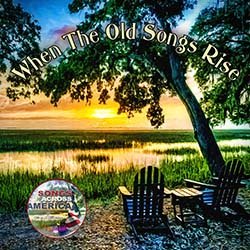
"When the Old Songs Rise©"
Release Date: April 2nd, 2026
*Link to American Spotlight: Traditions of The Gullah-Geechee
>
Lyrics by M. S. McKenzie | Performed by Songs Across America, Protected by Copyright
Streaming Services Music Link for Version I
Streaming Services Music Link for Version II
Streaming Services Music Link for Version III
Streaming Services Music Link for Version IV
~ Associated State Links ~
[ SC Home Pg. | SC Gallery Pg. | SC Attractions Pg. | Best Small Towns | Best Small Cities ]
"When the Old Songs Rise"
Why I Wrote This Song
I wrote "When the Old Songs Rise" as a tribute to Gullah Geechee music and memory surviving exactly what it was meant to survive. The song opens with real vocalizations, hey-ya, oh-way oh, wood strikes and stomps and claps, because I wanted the sound itself, not just the story, to carry the history. What was carried in silence, what was kept out of sight, starts to move in the body when it finds the night is the whole song's argument, that rhythm can hold what history tried to erase.
The story behind the song is the pre-chorus's defiance, no chain ever forged, no hand raised in hate, could silence the pulse that was born before the weight. I did not want to soften what was done to try to erase this culture, but I refused to let the song dwell only there. The point of the whole piece is that the erasure failed, and the proof of that failure is that the old songs are still rising, generation after generation, along the same reed beds and marsh lines where they were first kept alive in secret.
Songs Across America has room for history this hard, and I believe honoring it means insisting the culture built to survive erasure is still very much alive, not a memory but an ongoing rhythm still finding the night and rising.
Genre:
Percussive coastal roots music built on traditional call-and-response vocalizations, wood-strike and stomp rhythms, and a rising, anthemic chorus honoring survival and continuity.
Theme:
Gullah Geechee cultural survival, the endurance of rhythm and memory through slavery, ancestral resilience carried in the land and body, and the ongoing, present-tense continuity of a living tradition.
Primary Subject:
Gullah Geechee culture and music along the Lowcountry marshlands, its history of enslavement and the rhythm and memory that survived it.
Mood:
Haunting and defiant at the opening, deepening into righteous resilience, and closing on proud, unbroken continuity.
Core Message:
A culture built to withstand erasure carries its history not as a silence but as an unstoppable rhythm, and that rhythm rising again, generation after generation, is the clearest proof that the attempt to silence it failed.
Original Song Lyrics: Written by M. S. McKenzie, All Rights Reserved
[Percussive Intro / Traditional Vocalizations]
Hey-ya
Hey-ya
Oh-way oh
Oh-way oh
Eh-yo now
Eh-yo now
[wood strike]
[stomp stomp]
[clap]
[wood strike]
[stomp stomp]
[clap]
Hey-ya
Oh-way oh
Eh-yo now
Rise up
Rise up
[Verse 1]
Down where the reed beds lean when the night rolls in
And the moon lays silver on the skin of the wind
There's a sound in the floorboards, deep in the grain
Like the hush of old voices waking up again
From the edge of the marsh to the black water line
From the heat of the day to the cool moonshine
What was carried in silence, what was kept out of sight
Starts to move in the body when it finds the night
[Pre-Chorus]
You can hear it in the timber, in the heel, in the hand
Like a long-lost fire running under the land
No chain ever forged, no hand raised in hate
Could silence the pulse that was born before the weight
[Chorus 1]
When the old songs rise
You can feel them in the wood and the tide
What the dark could never hold
Comes back burning through the soul
[Verse 2]
They brought the iron morning and the language of fear
Turned sweat into sorrow year after year
Tore names from the mouth, tore kin from the shore
Still the beat found a way through the boards of the floor
In the ring of the feet, in the turn of the round
In the strike of the wood came a buried sound
Not broken, not gone, just waiting its hour
Like a root through stone, like a seed into flower
[Pre-Chorus]
Now it rolls through the lowland, through the pine and cane
Through the blood, through the breath, through the grief and pain
What they thought was gone is only gathering steam
And the ground starts talking when the people start to lean
[Chorus 2]
When the old songs rise
All the lost come back alive
What they buried won't stay down
Feel it shaking in the ground
[Breakdown / Stomp and Clap Section]
[wood strike]
[stomp stomp]
[clap clap]
[wood strike]
[stomp stomp]
[clap clap]
Hey now
Hey now
From the water to the shore
Hey now
Hey now
Hear the old heart roar
[Band enters harder]
Feet hit the boards now
Hands cut the air
Breath of the old world
Everywhere
Deep in the holler
Deep in the flame
Nobody living
Can erase that name
[Bridge]
Let it come up wild
Let it come up strong
Out of the wound
Out of the wrong
Out of the dark field
Out of the night
Out of the centuries
Into the light
No, not vanished
No, not done
Still in the daughters
Still in the sons
Still in the salt wind
Still in the rain
Still in the people
Calling that name
[Final Chorus 1]
When the old songs rise
You can feel them in the wood and the tide
What the dark could never hold
Comes back burning through the soul
[Final Chorus 2]
When the old songs rise
All the lost come back alive
What they buried won't stay down
Feel it shaking in the ground
[Outro]
Hey-ya
Oh-way oh
Eh-yo now
Still they rise
[wood strike]
[stomp stomp]
Still they rise
[wood strike]
[stomp stomp]
Out where the old songs rise
Song Description
"When The Old Songs Rise" is a powerful, rhythm-driven song of memory, survival, ancestry, and cultural reclamation. Rooted in the atmosphere of the Southern lowlands, the song evokes the world of marshes, black water, timber floors, salt air, and moonlit gathering places, while honoring a tradition that endured slavery, displacement, violence, and attempted erasure. This is not simply a song about the past. It is a song about what survives the past and rises through the present with force, dignity, and spiritual authority.
From its opening percussive vocalizations, hand-struck wood, stomps, and claps, the piece establishes itself as something deeply bodily and communal. It feels older than any one individual, as if the song is not being invented so much as awakened. The opening does an excellent job of creating the impression that rhythm itself is memory. Before the verses even begin, the listener is drawn into a space where sound, motion, and inherited tradition are inseparable. The music seems to come up from the ground, from the boards, from the body, and from generations of people who carried culture forward even when open expression was denied or punished.
Lyrically, the song is rich with atmosphere and symbolism. The setting is vividly drawn through images of reed beds, marsh edges, black water, moonlight, timber, pine, cane, and lowland terrain. These details root the song in a distinctly coastal Southern landscape, but they also do more than create scenery. The land itself becomes a witness and a vessel. Floorboards remember. The wind carries voices. The ground speaks. The tide and the wood hold history. This gives the song a spiritual depth, suggesting that memory lives not only in people, but in place itself.
Thematically, "When The Old Songs Rise" centers on the endurance of an oppressed people's cultural identity. The lyrics confront the brutality of enslavement directly, referencing the theft of names, kinship, language, and freedom. The phrase "the iron morning and the language of fear" is especially striking, because it compresses the machinery of oppression into something cold, invasive, and relentless. Yet the song refuses to let those forces have the final word. Again and again, it insists that something deeper could not be destroyed. The beat survived in the body. The sound survived in the ring of feet and the strike of wood. The spirit of the people remained intact, even when hidden, buried, or forced underground.
That is where the song's title becomes so important. "When The Old Songs Rise" suggests not nostalgia, but re-emergence. These songs are not relics. They are living inheritances. What was once suppressed begins to move again through rhythm, memory, and collective presence. The choruses capture this beautifully. They present the old songs as elemental, unstoppable forces that return through tide, timber, soul, and earth. The repeated sense that "what they buried won't stay down" transforms the song into an anthem of cultural survival. It becomes a declaration that truth, memory, and identity may be driven underground for a time, but they remain alive, gathering strength.
One of the strongest aspects of the lyric is the way it ties physical movement to spiritual awakening. The feet, hands, breath, boards, and bodily pulse are central throughout. This gives the song a ceremonial quality. It feels made to be experienced collectively, with people gathered, stomping, clapping, calling, and answering. The breakdown section intensifies that communal energy and feels like the moment where remembrance turns into open revival. By the time the band enters harder, the song has shifted from haunting remembrance into defiant resurgence. The old world is no longer whispering beneath the surface. It is fully present, embodied, and impossible to ignore.
The bridge is especially effective because it broadens the song from historical remembrance into generational continuity. The lines "Still in the daughters / Still in the sons" make clear that this inheritance is not frozen in the past. It lives on in descendants, in community, in ritual, in language, in movement, and in cultural identity carried forward. The bridge also transforms pain into power. What rises comes "out of the wound / out of the wrong," meaning the song is not denying suffering. It is showing how suffering did not annihilate the people who endured it. Instead, what emerges from that suffering is something fierce, sacred, and enduring.
Emotionally, the song carries grief, pride, reverence, and triumph all at once. It acknowledges historical horror without becoming defeated by it. It honors the dead and the silenced, but it does so by showing how their presence still moves through the living. That balance gives the piece its real strength. It is mournful in places, but never passive. It is defiant, but never hollow. It has the emotional force of a historical reckoning and the spiritual lift of a communal rising.
Overall, "When The Old Songs Rise" feels like an anthem of ancestral memory and cultural endurance. It is a song about voices that were never truly extinguished, rhythms that survived in hidden places, and traditions that continue to rise through the people, the land, and the music itself. With its earthy imagery, percussive energy, and themes of survival and return, it stands as a stirring tribute to those who carried identity forward through unimaginable hardship and to those who continue to keep that inheritance alive today.












Featured Songs



.jpg)

Leave a Tip